

Golf Bag Humidor: What Actually Works on the Course
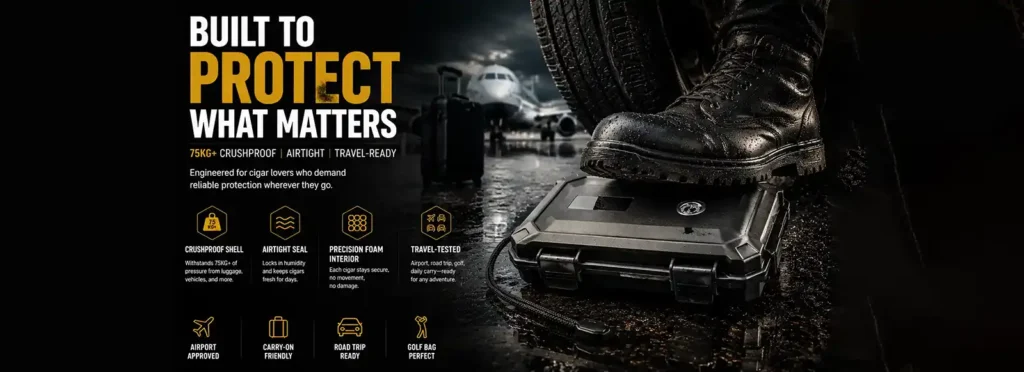
A golf bag is a bad place for cigars. It sits in the sun, gets thrown into a cart, and spends four hours vibrating against clubs. A “golf humidor” is not a special product category — it is a travel humidor that survives that environment. Here is what actually works.
What a golf bag does to cigars
- Heat. A black bag in the sun, or a closed car boot, can hit 50C inside. Above roughly 22C tobacco beetles can hatch, and heat drives humidity out of the wrapper.
- Vibration. Clubs rattle against everything. A cigar that is not held in foam will chip at the foot and crack the wrapper.
- Dry air. Most days on the course are 40–60% RH. A ziplock bag is not a humidor; it equalises within an hour.
What works: a hard case in the side pocket
The practical setup is a 5-cigar crushproof case in the side pocket of the cart bag, not in the main compartment where the clubs are.
- Hard shell. ABS or polycarbonate spreads the load when a club lands on the bag.
- Foam cut-outs. Each cigar sits in its own slot instead of rolling against the next one.
- A real gasket. The seal is what holds 65–72% RH for the round; foam alone only cushions.
- A gauge on the lid. You can check humidity without opening the case in the sun.
The Explorer Series Flagship is built for this: 9.25 x 5.7 x 1.93 inches, 0.91 lb, IP67, with the hygrometer mounted on the lid. It fits a cart-bag side pocket and holds five cigars up to 60 ring gauge — enough for 18 holes and the 19th.
What does not work
- A ziplock bag. No structure, no humidity control, and cigars still break.
- A leather case. Looks better than it performs on a course: leather breathes, and a soft case does nothing against a club head.
- A dry box or cedar case. Cedar needs humidity to stay stable; in a hot bag it dries out and pulls moisture from the cigars.
- Leaving the case in the cart’s open tray. Direct sun for four hours undoes a charged humidifier faster than anything else on this list.
Packing for 18 holes
- Charge the humidifier or add a Boveda 69% pack the night before.
- Put four or five cigars in the case — two for the round, one or two for after, one spare.
- Add a cutter and a torch lighter in the bag’s accessory pocket, not inside the case (a torch lighter has its own travel rules if you are flying to the course).
- Put the case in the side pocket, lid up, away from the club heads.
- After the round, take the case out of the bag rather than leaving it in a hot car.
After the round
Open the case, check the gauge, and let it air for a minute before closing. If you smoked in humid weather, the foam may be damp — that is fine, but do not seal a wet case for a week. Recharge before the next round and keep it out of the sun in between.
More on the golf side
If you want the longer packing routine for a golf weekend, the golf travel humidor guide covers heat, cart bags and 65-70% RH through 18 holes. For the case itself, see the 5-cigar Flagship.
Flying to the course
The case is allowed in carry-on and checked baggage; the lighter rules are separate. The travel humidor TSA rules cover what goes in the cabin and what stays home.
Frequently asked questions
Is a golf humidor different from a travel humidor?
No. “Golf humidor” is a use case, not a product category. Any crushproof 5-cigar travel humidor with a seal and foam does the job; the ones sold as golf-specific are usually the same ABS case with a different label.
How many cigars do I need for a round?
Two for the round and one or two spares. A 5-cigar case covers a full day of golf with room left over.
Will the heat in my bag ruin the cigars?
A sealed case slows the change, but it cannot cool anything. Do not leave the bag in a closed car or the boot of a car on a hot day; that is what actually ruins cigars.
Can I keep the case in the bag between rounds?
For a day or two, yes, as long as the bag is indoors. For longer, take the case out, check the gauge and store it somewhere stable.