

How to Travel With Cigars Without Ruining Them (2026 Guide)
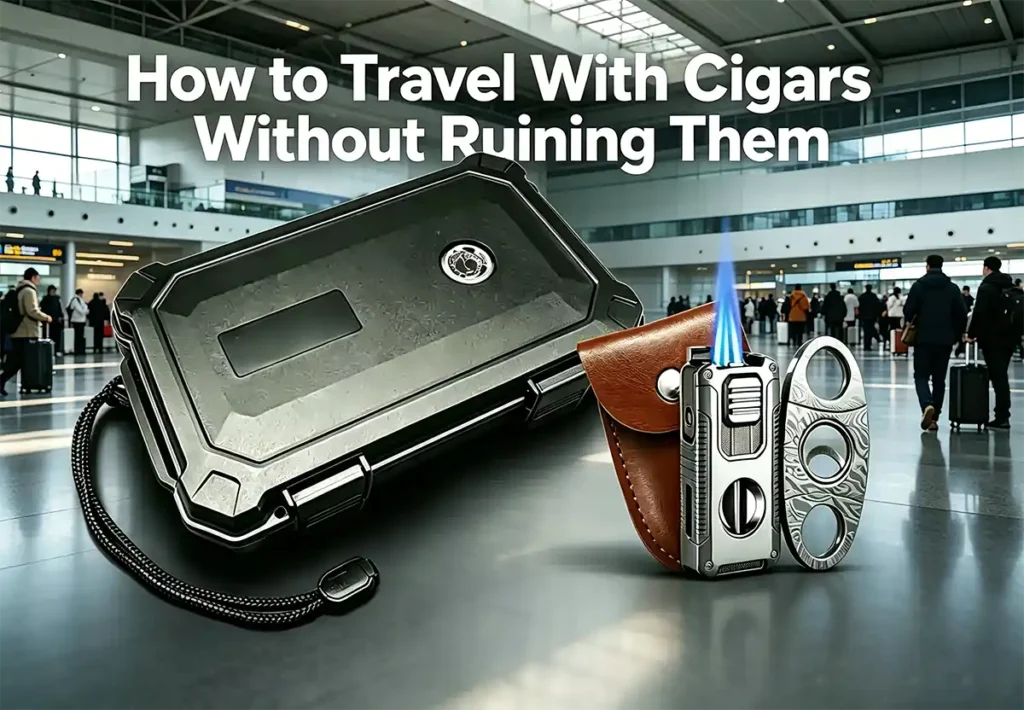
Most cigar damage happens during travel — not storage.
- Cracked wrappers
- Dry tobacco
- Crushed cigars
- Flavor loss from heat & pressure
One dry flight cabin can ruin hundreds of dollars worth of premium cigars before your trip even begins.
And the worst part? Most smokers don't realize the damage until they light up the first cigar.
How to travel with cigars without ruining them is one of the most common questions among cigar lovers who fly frequently. This guide will give you the answers you need – from emergency short‑term fixes to TSA rules and the right long‑term gear.
Why Traveling Is One of the Fastest Ways to Ruin Premium Cigars
You've carefully stored your cigars at home — perfect humidity, stable temperature. Then you pack them for a trip. Within hours, everything changes. Airplane cabins have extremely low humidity (often below 20%). Checked luggage experiences dramatic pressure shifts. A car dashboard can reach 50°C in summer. And a soft leather case? It looks elegant but offers almost no protection against crushing or temperature fluctuations.
A cigar can look perfectly fine on the outside while already losing oils and flavor internally. By the time you light it, the draw is tight, the burn is uneven, and the taste is flat. That's why learning how to travel with cigars without ruining them is essential for any aficionado.
Emergency Fixes: How to Travel With Cigars Without a Humidor (Short‑Term Only)
Maybe you're already on the road, or you don't own a travel humidor yet. Here are three temporary solutions that can work for a weekend trip — but read the limitations carefully.
1. The Ziploc & Boveda Bag – Most Reliable Short‑Term Bet
Place your cigars inside a high‑quality, freezer‑grade Ziploc bag. Add a small 69% Boveda humidity pack, gently press out excess air, and seal it. Stored in a cool, dark place (like your hotel room), this can keep your cigars fresh for 3‑5 days. Downside? Zero protection against crushing — one suitcase on top and your cigars are flattened.
2. The Tupperdor – More Stable, But Still Not Built for Travel
An airtight plastic food container with a sealing gasket creates a better micro‑environment than a bag. Fine for a road trip, but the rigid sides and bulkiness make it impractical for air travel or a night out. Also, it offers no foam padding.
3. The Leather Cigar Sleeve – Style Over Substance
Leather sleeves look elegant and protect the wrapper from minor scuffs. However, they are not airtight and offer no structural protection – a crushed cigar in a leather sleeve is still a ruined cigar.
Important: These are emergency fixes only. For any trip longer than a few days, or if you care about your cigars, you need a proper travel humidor. The rest of this guide explains why.
Do's and Don'ts of Flying With Cigars & Accessories
Traveling with your cigars on a plane doesn't have to be stressful. A little extra preparation will keep your cigars and accessories safe from confiscation or damage.
✅ Do's
- Keep cigars in your carry‑on. Cabin conditions are climate‑controlled and far more stable than the cargo hold. Checked luggage also gets thrown around more.
- Pack only what you'll smoke. Overpacking wastes space and makes your bag more likely to be inspected. Technically there's no limit, but fewer cigars = less risk.
- Check local cigar import limits when traveling outside the U.S. Some countries restrict how many cigars you can bring.
- Secure sharp objects like cigar cutters properly – sheath them or wrap them to prevent injury to baggage handlers and TSA officers.
- Use a hard‑shell travel humidor to protect against pressure changes and crushing. Our Explorer Series is specifically designed for this.
❌ Don'ts
- Don't put torch lighters in carry‑on or checked bags. TSA prohibits torch lighters entirely. Soft‑flame lighters are allowed in carry‑on but not checked.
- Don't assume cigar cutters are always allowed. While straight and punch cutters are generally fine, some security agents may be strict. When in doubt, pack them in checked luggage or leave expensive ones at home.
- Don't travel with expensive or irreplaceable cutters and lighters. Bags get lost. Keep your everyday gear with you, but leave heirlooms at home.
- Don't rely on soft leather cases for checked luggage. They offer zero structural protection. Always use a crushproof case if you must check a bag.
The Wrong Way vs The Right Way to Travel With Cigars
| Wrong Way | Right Way |
|---|---|
| Soft leather pouch (looks good, no structure) | Hard‑shell travel humidor with foam insert |
| Loose cigars thrown in backpack | Foam‑secured individual slots |
| No humidity control | Boveda pack + airtight seal |
| Checked luggage (extreme temps & pressure) | Carry‑on protection |
How to Travel With Cigars Without Ruining Them: Key Strategies
Whether you're flying, driving, or taking a train, three factors matter most: humidity, heat, and physical protection.
Control Humidity
Use a small Boveda pack (65% or 69%) inside your travel humidor. It will maintain stable RH even during long flights. Avoid using wet sponges — they can leak and create mold.
Avoid Heat Exposure
Never leave cigars inside a parked car, in direct sunlight, or near a heater. Heat accelerates the loss of essential oils and can cause wrappers to crack.
Protect Against Crushing
A soft leather sleeve won't stop your cigars from being crushed by a laptop or a suitcase. A hard‑shell travel case is the only reliable defense.
Can You Bring Cigars on a Plane?
Yes, the TSA allows cigars in both carry‑on and checked baggage. There is no limit on quantity for personal use. However, torch lighters are prohibited (soft‑flame lighters are allowed in carry‑on). Most experienced smokers prefer carrying their cigars in a hard‑shell travel humidor inside their carry‑on — that way they control temperature and pressure, and they avoid the risk of lost baggage.
Should You Put Cigars in Checked Luggage?
Technically you can, but it's not recommended. Cargo holds experience extreme temperature swings and pressure changes. Your cigars can freeze, then thaw, then get crushed under heavy bags. Soft leather cigar cases protect appearance — not structure. If you must check a bag, use a crushproof hard case and remove any lighters. But the golden rule: always keep your cigars with you in the cabin.
Why Cheap Travel Cases Fail (Real‑World Test)
We compared a standard leather cigar case to a sealed hard‑shell travel humidor during a 6‑hour dry‑air exposure test (simulated cabin conditions).
| After 6 Hours | Leather Case | Hard-Shell Humidor |
|---|---|---|
| Humidity Retention | Significant moisture loss | Stable humidity |
| Wrapper Condition | Slight cracking | No visible damage |
| Pressure Protection | Minimal | High protection — withstands 75kg+ static pressure |
Travel Humidor vs Leather Cigar Case
Leather cases are beautiful for short, risk‑free occasions (dinner, cigar lounge). But for flights, road trips, or checking bags, they fail completely. A genuine travel humidor offers:
- Airtight seal – Locks humidity in, dry air out.
- Crushproof shell – Withstands 75kg+ static pressure, tested against drops and luggage stacking.
- Foam interior – Holds each cigar firmly without movement.
- Boveda compatibility – Stable RH for days.
Here's Why We Built the Explorer Series
The ProTravelHumidors Explorer Series was designed specifically for short trips, flights, golf weekends, and everyday carry. It combines everything a traveling smoker actually needs:
- Hard‑shell protection – Built to survive backpacks, overhead bins, golf bags, and road trips without crushing your cigars. Tested to withstand 75kg+ static pressure.
- Airtight silicone seal – Locks in humidity even at 30,000 feet. No more dried‑out cigars after a long flight.
- Precision foam interior – Custom‑cut to hold cigars firmly without movement; fits up to 60 ring gauge.
- Built‑in mechanical hygrometer – Know the humidity at a glance without breaking the seal.
- Ultra‑slim profile – Slides easily into a carry‑on, briefcase, or glove box.
It's not a leather pouch dressed up for Instagram. It's a tool built for real travel — tested against pressure changes, drops, and repeated use.
📘 Want a complete overview of travel humidors? Read our Complete Guide to Travel Humidors – covers types, features, maintenance, and how to choose the right one for your trips.
Frequently Asked Questions About Traveling With Cigars
Yes. Cabin humidity is extremely low during flights (often under 20%). Without an airtight seal, your cigars can lose moisture in a matter of hours. A travel humidor with a silicone gasket prevents this.
With a proper airtight seal and a Boveda pack, several days to a week. The Explorer Series can maintain stable RH for up to two weeks.
For short, low‑risk trips — maybe. For flights, long drives, or checked luggage, absolutely not. Leather offers no structural protection against crushing or pressure.
Straight cutters and punch cutters are generally allowed. V‑cutters with small blades are also fine. For a high‑quality option, check our Damascus cigar cutter. However, always check current TSA rules before flying. Torch lighters are prohibited.
For the latest TSA regulations on cigars and lighters, you can visit the official TSA website. Always verify rules before your flight.
Stop trusting soft cases with premium cigars.
Protect Your Cigars Before Your Next Flight →